
Custom Website vs Template Website: Which Is Better for Your Business?
In today’s digital world, your website is often the first impression potential customers have of your business. Whether someone finds you through Google, social media, or a recommendation, they will likely visit your website before making a purchasing decision. That is why understanding the difference between a custom website vs template website is one of the most important decisions businesses face when building an online presence.
While both options help businesses get online, they offer very different advantages in terms of branding, flexibility, SEO performance, scalability, and long-term growth. Businesses looking to build scalable digital systems and professional websites can also explore ROBZZ Digital web development services for custom development and business-focused digital solutions.
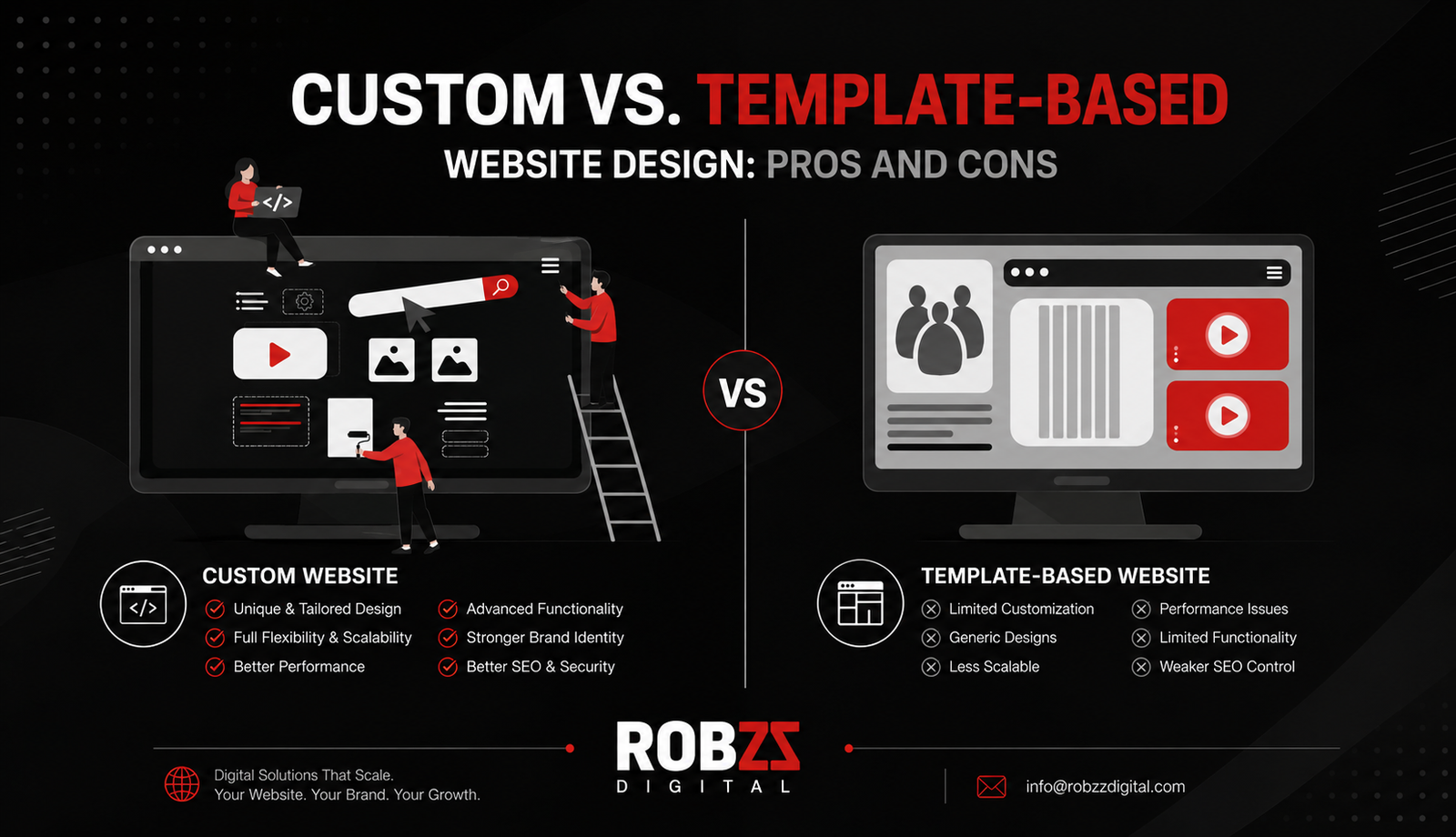
Key Takeaways
- Template websites are affordable and faster to launch
- Custom websites provide stronger branding and scalability
- Templates are suitable for startups and smaller projects
- Custom websites offer better SEO and flexibility
- The best option depends on business goals and long-term growth plans
Understanding the Difference Between Template and Custom Websites
What Is a Template Website?
A template website uses a pre-designed layout available through platforms such as WordPress, Wix, Squarespace, or Webflow.
Businesses can quickly customize:
- text,
- branding,
- colors,
- and images
without building a website from scratch.
Template websites are popular because they reduce development time and initial costs.
What Is a Custom Website?
A custom website is fully designed and developed specifically for a business.
Every element is tailored to:
- business goals,
- customer behavior,
- branding,
- and operational requirements.
Custom websites offer greater control over:
- user experience,
- functionality,
- scalability,
- and long-term performance.
Why Businesses Choose Template Websites
The Advantages of Template Websites
Many startups and small businesses choose templates because they offer:
- lower upfront costs,
- faster launch times,
- easy content management,
- and attractive pre-built designs.
Templates are especially useful for:
- new businesses,
- freelancers,
- portfolios,
- and minimum viable products (MVPs).
The Limitations of Template Websites
Although templates are convenient, they often come with restrictions.
Common limitations include:
- generic layouts,
- slower performance,
- limited customization,
- and scalability issues.
Businesses using heavily modified templates may also experience:
- bloated code,
- SEO limitations,
- and reduced website speed.
According to Google PageSpeed Insights, website performance and loading speed play a major role in both SEO rankings and user experience.
Why Custom Website Design Offers Long-Term Value
Stronger Branding and Identity
One of the biggest advantages of a custom website vs template website is branding flexibility.
Custom websites help businesses create:
- unique visual identities,
- stronger customer trust,
- and memorable online experiences.
Research shows users form opinions about websites within milliseconds, making first impressions critically important.
Better User Experience and Conversion Optimization
Custom websites are built around customer behavior and business objectives.
This allows businesses to create:
- strategic navigation,
- clear calls-to-action,
- simplified customer journeys,
- and optimized conversion paths.
A strong user experience often improves:
- engagement,
- retention,
- and lead generation.
Businesses interested in improving website performance can also explore Nielsen Norman Group UX Research for usability and UX insights.

SEO Benefits of Custom Website Development
Custom Websites Perform Better on Search Engines
SEO performance is one of the most important differences between a custom website vs template website.
Custom websites often provide:
- cleaner code,
- faster loading speeds,
- improved mobile responsiveness,
- and advanced technical SEO capabilities.
These improvements help websites perform better under:
- Google Core Web Vitals,
- mobile-first indexing,
- and technical SEO standards.
Custom websites also allow businesses to implement:
- schema markup,
- structured metadata,
- optimized site architecture,
- and advanced SEO strategies.
Businesses can learn more through Google Search Central SEO Guide.
Scalability and Future Business Growth
Why Flexibility Matters
As businesses grow, websites often require:
- integrations,
- CRM systems,
- automation tools,
- ecommerce functionality,
- and custom workflows.
Custom websites are designed with scalability in mind, allowing businesses to expand functionality without rebuilding the entire system.
This flexibility becomes especially valuable for:
- growing companies,
- ecommerce brands,
- SaaS businesses,
- and enterprise-level operations.
Cost vs Long-Term Return on Investment
The Real Question Is Long-Term Value
Template websites usually cost less initially, but custom websites often provide stronger long-term returns through:
- higher conversion rates,
- stronger SEO performance,
- improved branding,
- better customer retention,
- and increased lead generation.
The true value of a website should be measured by:
- business growth,
- operational efficiency,
- and long-term scalability.
Which Option Is Best for Your Business?
Choose a Template Website If:
- your budget is limited,
- you need a website quickly,
- your requirements are simple,
- or you are launching an MVP.
Choose a Custom Website If:
- your website is central to business growth,
- you need advanced functionality,
- you operate in a competitive market,
- or you want stronger branding and scalability.
Businesses looking for scalable development and modern digital systems can also explore ROBZZ Digital custom web development solutions.
Final Thoughts
Choosing between a custom website vs template website affects much more than design alone. It impacts:
- branding,
- SEO visibility,
- customer experience,
- scalability,
- and long-term business growth.
While template websites offer affordability and speed, custom websites provide the flexibility, performance, and professional experience needed for sustainable growth in competitive markets.
The right choice ultimately depends on your:
- business goals,
- budget,
- operational needs,
- and long-term vision.